
Introduction
Buy Now, Pay Later (BNPL) has moved beyond occasional online purchases and is increasingly being used to finance everyday expenses. In the US, consumers are increasingly using installment payment plans for groceries, travel, medical expenses, electronics, furniture and other everyday purchases. The shift is changing BNPL spending habits and making short-term credit part of routine household budgeting. Federal Reserve survey data shows that 16% of US adults used BNPL in 2025, up from 10% in 2021.
The change matters because BNPL is not simply competing with credit cards at checkout. It is altering how consumers evaluate the affordability of a purchase. Instead of asking whether they can pay the full price today, shoppers increasingly consider whether they can manage a series of smaller payments over several weeks.
BNPL Is Moving From Big Purchases to Everyday Spending
The original BNPL model was largely associated with online retail and discretionary purchases. A customer could select a pay-in-four option at checkout, make an initial payment and divide the remaining balance into scheduled installments, often without interest when payments were made on time.
That model is still widely used, but the range of purchases has expanded considerably.
The Federal Reserve's 2025 Survey of Household Economics and Decision making (SHED) found that 49% of BNPL users had used the service for clothing or accessories, while 32% used it for electronics and 26% for furniture or appliances. More significantly, 20% used BNPL for groceries or food delivery, 19% for travel expenses and 8% for medical or veterinary procedures.
This expansion changes the role of BNPL. It is no longer limited to financing a television, laptop or fashion purchase. For some households, it has become another mechanism for managing cash flow.
The distinction is important. Financing a $600 electronic purchase over several installments is different from using BNPL for a $100 grocery bill. The latter suggests that the product is increasingly being used when consumers have difficulty matching immediate expenses with available cash.
The Federal Reserve found that consumers using BNPL for groceries or food delivery were more likely to experience late-payment charges or an overdraft or non-sufficient funds fee than users financing several other categories.
Why BNPL Changes the Way Consumers Think About Affordability
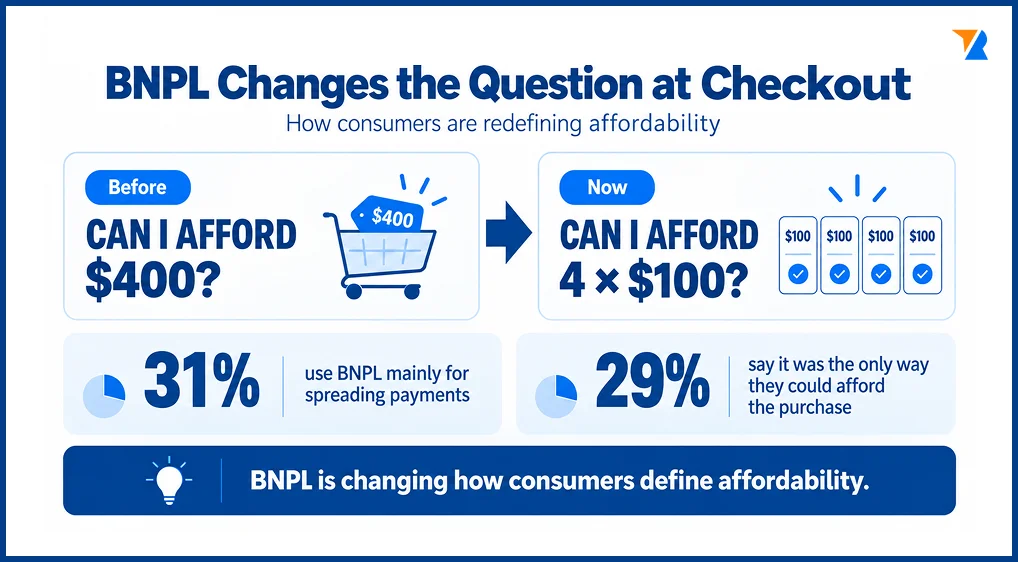
BNPL shifts attention from the total purchase price to smaller installment payments. A $400 purchase, for example, can be presented as four $100 payments, making the expense appear easier to manage within monthly cash flow.
The Federal Reserve found that 31% of BNPL users in 2025 used it primarily to spread out payments, while 29% said it was the only way they could afford the purchase.
The convenience of pay later checkout financing subprime lending trends
also supports this shift. BNPL is integrated directly into merchant checkouts, apps and digital wallets, allowing consumers to access installment payment plans without applying for a separate traditional loan.
For consumers, BNPL can therefore feel less like borrowing and more like another payment method. That distinction is central to changing BNPL spending habits
BNPL vs Credit Cards Is Becoming Less Straightforward
BNPL is often positioned as an alternative to credit cards, but the two products increasingly overlap.
Feature | BNPL | Credit Cards |
Typical repayment | Fixed installments | Revolving balance or fixed-payment plans |
Interest | Often no interest for short-term plans, depending on provider | Interest generally applies when balances are carried |
Payment structure | Predetermined number of installments | Minimum payment with flexible repayment |
Checkout integration | Directly embedded in many online purchases | Widely accepted online and in stores |
Credit reporting | Reporting practices vary by provider and product | Generally reported to credit bureaus |
Main appeal | Predictable short-term payments | Flexibility, rewards and broader credit access |
Main risk | Payment stacking and missed installments | Revolving debt and interest accumulation |
The Federal Reserve's 2026 research shows that BNPL is also expanding beyond the traditional “pay in four” model. Providers increasingly offer short- and longer-term installment loans, creating a broader category of point-of-sale financing rather than a single standardized product.
That makes buy now pay later vs credit cards buy now pay later regulation
a more complicated comparison. Consumers may use both products simultaneously rather than choosing one exclusively.
In fact, the Consumer Financial Protection Bureau found that more than 60% of BNPL borrowers in its analysis had multiple simultaneous BNPL loans at some point, while one-third had loans from multiple providers. The research also found that BNPL borrowers tended to have higher balances on other unsecured credit lines, including credit cards.
The Consumer Debt Cycle Is the Bigger Concern
The bigger risk isn't installment payments themselves. It's accumulating several obligations that seem manageable individually but compete for the same paycheck when combined, a pattern often called payment stacking.
Federal Reserve data highlights the risk: 26% of BNPL users reported a late payment in 2025, and 11% said a BNPL payment triggered an overdraft or NSF fee. Among consumers with less than $100 in emergency savings, 18% experienced such an event, compared with just 4% of those able to cover $2,000 or more.
The risk is sharpest for essential spending: 43% of users who financed groceries hit a late fee or overdraft, versus 34% for medical expenses and 20% for electronics. This doesn't mean BNPL causes hardship. It shows that consumers already facing tighter liquidity are more likely to use it and run into repayment trouble.
BNPL Is Becoming a Broader Alternative Credit Product
BNPL is emerging as an alternative credit product between credit cards and traditional personal loans. The CFPB estimated that BNPL loans grew from 19.8 million in 2019 to 335.8 million in 2023, while dollar volume rose from $2.7 billion to $45.2 billion.
Growth has continued, with Worldpay reporting that BNPL accounted for 6% of US e-commerce transaction value in 2025 and projecting 8% by 2030. Providers are also expanding into digital wallets, virtual cards and physical retail, making installment financing more accessible across the purchasing journey.
For merchants, BNPL can make higher-priced purchases more manageable. For consumers, its wider availability also increases the number of everyday purchases that can be financed.
Regulation Will Shape the Next Phase of BNPL
The growing use of BNPL has increased regulatory attention, particularly around transparency, affordability and consumer protection.
In the US, the regulatory framework remains more complicated than simply treating every BNPL product as identical. The CFPB withdrew its 2024 BNPL interpretive rule in May 2025, while continuing to provide compliance resources for companies operating BNPL products.
The regulatory debate is significant because traditional credit products and BNPL products have historically operated under different structures. Questions around credit reporting, dispute rights, late fees, underwriting and affordability assessments remain important as the market expands.
For consumers, buy now pay later regulation matters because the protections and costs associated with a product can depend on the provider and the specific financing structure.
For financial institutions and merchants, regulation also affects how BNPL can be integrated into payment systems without creating additional compliance risks.
What Changing BNPL Spending Habits Mean for Consumers
BNPL is unlikely to simply replace credit cards. Instead, the two are becoming parts of a broader payment ecosystem in which consumers choose financing based on purchase size, repayment period, convenience and perceived cost.
The more important shift is behavioral. When installment options appear directly beside the purchase price, consumers can begin evaluating affordability through recurring payments rather than the total amount due immediately.
That can provide legitimate budgeting flexibility when payments are predictable and affordable. It can also contribute to a consumer debt cycle when multiple installment plans accumulate or BNPL is repeatedly used to cover essential expenses.
The Federal Reserve's 2026 analysis captures the central issue: consumers with limited financial reserves are more likely to use BNPL, while those using it for necessities such as groceries are more exposed to repayment problems.
What the Shift Means for Consumer Finance
BNPL use is becoming mainstream: 16% of US adults used BNPL in 2025, compared with 10% in 2021.
Everyday purchases are entering the BNPL market: 20% of BNPL users used it for groceries or food delivery in 2025.
Payment flexibility is the primary appeal: 31% of users identified spreading payments as their most important reason for using BNPL, while 29% said it was the only way they could afford the purchase.
Payment stacking remains a major risk: CFPB research found that more than three-fifths of BNPL borrowers held multiple simultaneous loans at some point.
BNPL is expanding beyond pay-in-four: Longer-term installment products are broadening BNPL into a wider point-of-sale financing category.
The key change is behavioral: BNPL is shifting spending decisions from evaluating an upfront price toward evaluating whether a series of future payments fits into household cash flow.