
Introduction
Anthropic's Claude Mythos has moved AI-driven vulnerability discovery from a theoretical risk to a practical cybersecurity capability with implications for the financial sector. Since Project Glasswing launched in April 2026, Anthropic and its initial group of roughly 50 partners have used Mythos to identify more than 10,000 high- or critical-severity vulnerabilities across systemically important software. Anthropic later expanded the program to approximately 200 organizations, including critical infrastructure operators.
For banks and credit unions, that combination of speed and scale could change how security teams detect vulnerabilities, assess vendors, and demonstrate cyber readiness to regulators. This article breaks down what Mythos banking cybersecurity actually means in practice: where the model is helping defenders, where it's creating new exposure, and what boards and security leaders should be doing about it right now.
How Mythos Changes Both Vulnerability Detection and Exploitation
Claude Mythos Preview is an unreleased frontier model that Anthropic developed with advanced coding and reasoning capabilities, showing significant potential for vulnerability discovery and exploit development. Anthropic has not made it broadly available. Instead, Anthropic has made Mythos Preview available to vetted organizations participating in Project Glasswing, a defensive initiative that includes companies such as Apple, Broadcom, Cisco, CrowdStrike, Google, JPMorganChase, Microsoft, NVIDIA, Palo Alto Networks, and the Linux Foundation.
The results so far illustrate why this is agentic AI cybersecurity in financial services rather than an incremental tooling upgrade. In pre-release testing, Mythos reproduced vulnerabilities and built working exploits on the first attempt in more than four out of five cases, uncovered a 27-year-old OpenBSD flaw that had survived decades of human review, and chained four independent bugs into an exploit that bypassed both browser-renderer and operating-system sandboxing. Some Project Glasswing partners reported vulnerability-discovery rates more than 10 times higher than their previous rates when using Mythos. That is the core of the frontier AI cybersecurity risk conversation: a single system can now find, and in many cases weaponize, flaws that used to take specialist teams months to locate.
A few architectural features drive this jump in capability:
- Full-codebase reasoning: Mythos can reason across large and complex codebases, allowing it to identify relationships between components that may be missed when files are analyzed independently.
- Self-correcting analysis loops: It can test hypotheses, evaluate results, adjust its approach, and retry without requiring step-by-step human guidance.
- Direct system interaction: It can launch debuggers and interact with the systems it's analyzing rather than just describing what a human should do next.
- Autonomous execution: In controlled environments, Mythos can form hypotheses, execute code, launch tools, and conduct multi-step vulnerability discovery and exploitation with limited human intervention.
This is the core of agentic AI cybersecurity financial services teams now have to plan around: the model doesn't just point out a weakness, it can act on it.
How AI Changes the Speed of Vulnerability Discovery
The reason Mythos is generating both excitement and concern is that the same coding, reasoning, and system-interaction capabilities can support both vulnerability discovery and exploitation. A security team using Mythos or comparable AI systems defensively can scan codebases, prioritize vulnerabilities based on actual exposure, and accelerate remediation before attackers exploit them. An attacker with equivalent capability can do the same thing against a target that hasn't patched yet.
This is what's meant by AI vulnerability detection banks now need to take seriously on both sides of the ledger:
| Capability | Defensive use | Offensive risk |
| Full-codebase reasoning | Finds hidden flaws across legacy and modern systems in one pass | Locates the same flaws before a patch cycle catches them |
| Autonomous exploit chaining | Red-team simulations without waiting on external testers | Links minor bugs into a single high-impact attack path |
| Rapid triage | Cuts alert fatigue by ranking real exposure over noise | Shortens the time between disclosure and active exploitation |
| Lateral movement mapping | Reveals blind spots in network segmentation before go-live | Maps and exploits internal systems within hours of a breach |
Independent testing, including work by the UK's AI Security Institute, found that Mythos could not reliably execute autonomous attacks against organizations with genuinely well-hardened defenses. That finding matters: the model doesn't create new weaknesses out of nothing. It exposes weaknesses that were already there, including outdated patch cycles, flat network architecture, and weak identity controls, and does so at a speed that removes the safety margin institutions used to rely on.
Why Banks Face Higher AI Cybersecurity Risks
Every industry is affected by frontier AI's growing cybersecurity capability, but a few structural realities make financial services particularly exposed to frontier AI cybersecurity risk:
1. Deep legacy footprints.
Core banking platforms, payment rails, and specialist applications often date back decades, layered with patches and workarounds that were never designed with this threat speed in mind. This is the essence of bank cybersecurity legacy systems AI concerns: complexity that once slowed attackers down no longer offers meaningful protection, because AI cuts through it at machine speed.
2. Shared technology stacks.
Banks frequently rely on the same core platforms, payment processors, and security vendors as their competitors. A single exploitable flaw in a widely used product doesn't stay contained to one institution it becomes an industry-wide exposure almost overnight.
3. Heavy third-party dependency.
Outsourced services, managed security providers, and fintech integrations all extend the attack surface well beyond the bank's own walls. For many institutions, internet-facing services and third-party or managed-service-provider connections represent the single biggest source of fast-moving exposure.
4. Regulatory scrutiny on both sides.
Institutions are expected to detect and disclose incidents quickly, while also being newly answerable for how they use AI internally creating pressure from the threat itself and from the compliance obligations wrapped around it.
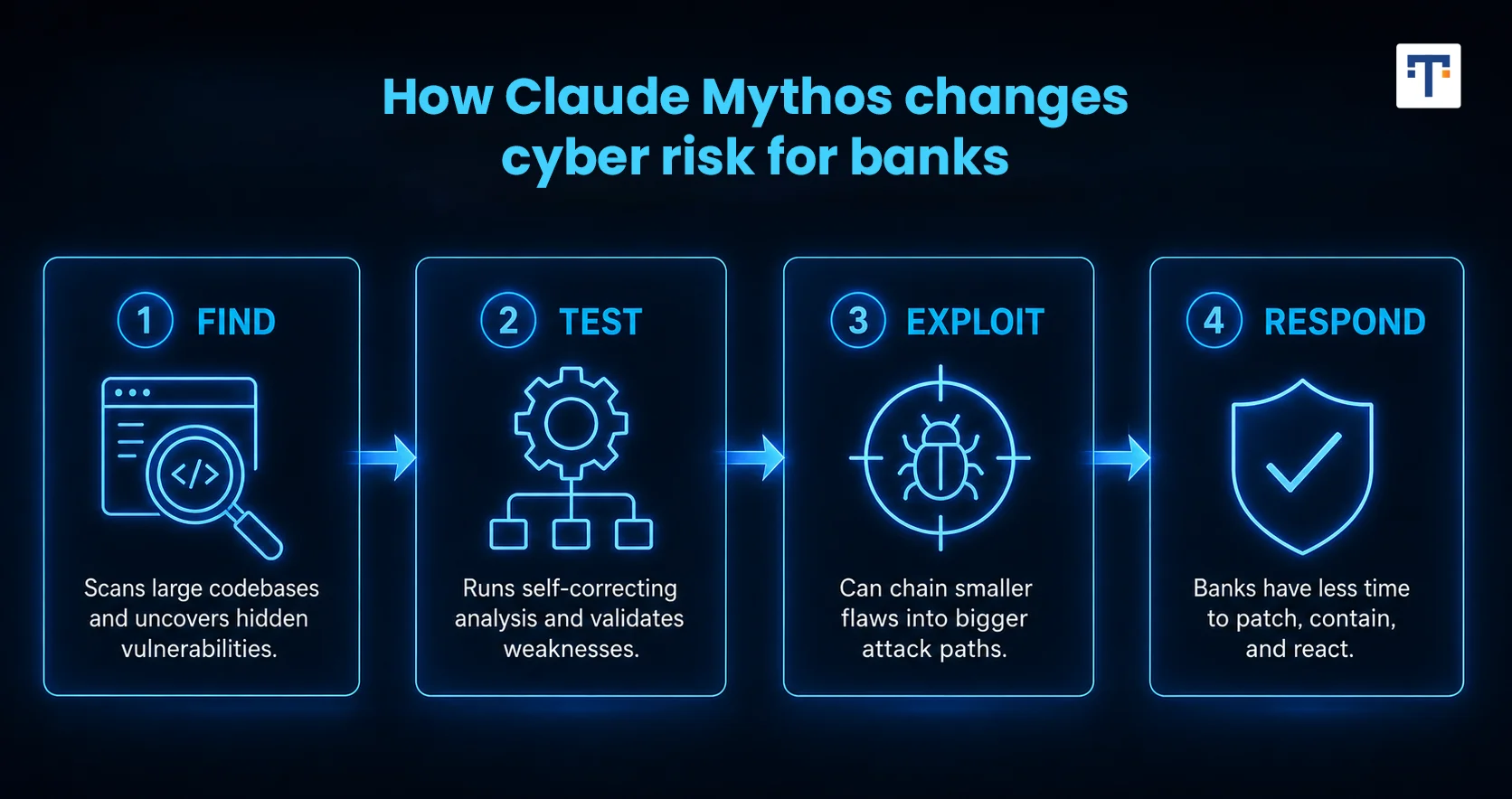
Together, these factors explain why AI-driven cyberattacks in banking are not just a technology upgrade problem. They are also a governance problem that affects vendor contracts, patch policies, and board-level risk reporting.
How Regulators Are Responding to AI Cybersecurity Risks
- Regulators haven't waited for a real-world incident to react. Frameworks already in force or taking effect are converging on the same expectation: institutions must know, quickly and with evidence, how exposed they are.
- DORA (Digital Operational Resilience Act) in the EU formalizes ICT risk management, incident reporting, penetration testing, and third-party risk oversight as board-level obligations, not IT housekeeping.
- The EU AI Act adds a parallel governance layer specifically for AI systems, requiring institutions to track where AI is embedded in their own operations and their vendors' products.
- SEC cybersecurity disclosure rules in the US raise the bar on what boards must know and disclose about material incidents.
- Supervisory bodies, including the European Central Bank, have warned that a significant share of serious ICT incidents can be traced to changes made under time pressure, a dynamic that Mythos-class tools could accelerate.
How Financial Institutions Should Prepare for AI-Driven Cyber Risks
Security leaders don't need to wait for public access to Mythos-class models to start closing gaps. The following priorities apply regardless of which frontier model eventually becomes the industry benchmark:
- Stand up a dedicated AI-enabled threat function. Reallocate existing security and AI talent to actively probe your own systems using the same class of tools attackers will use, rather than waiting for an external signal.
- Compress patch and remediation timelines. Vulnerability tracking and committee review remain necessary, but the real metric that matters now is how fast a confirmed flaw actually gets fixed in production.
- Harden identity and access controls. Phishing-resistant multi-factor authentication limits how far a compromised credential can travel, which matters more as autonomous AI exploit detection tools make credential theft easier to scale.
- Reassess legacy and third-party exposure together. Poorly documented legacy applications and loosely governed vendor relationships were already risk factors; ask vendors directly whether and how AI is embedded in the products and services connected to your environment.
- Adopt AI for internal threat detection now. Using currently available models to triage alerts, prioritize real exposure over generic severity scores, and speed up incident documentation builds the operational muscle needed before more advanced tools become standard. This is where AI threat detection financial services teams put into practice today pays off directly when the threat landscape shifts again.
- Report cyber readiness in board terms, not technical terms. Track time-to-identify, time-to-contain, and time-to-communicate as core metrics, and make sure leadership can answer, with evidence, whether the institution can move faster than the threat.
None of this requires panic, and none of it is optional. Mythos did not create new weaknesses in banking IT; it simply reduced the time institutions have to identify and fix existing vulnerabilities before they are exploited. Firms that treat this as a permanent shift in operating speed, rather than a one-time headline, will be better prepared when more capable AI models emerge.